The science behind Signal Chemistry.
Signal Chemistry separates amplification from signal generation — enabling broad multiplex panels on the instruments already on your bench, without adding hardware or complexity.
Signal Chemistry vs. TaqMan · Amplification Curves · Head-to-Head
What is Signal Chemistry?
Traditional PCR couples amplification and detection into one reaction. Signal Chemistry decouples them — creating a fundamentally different architecture for multiplexing.
Target Amplification
Standard PCR primers amplify targets. No changes to your upstream workflow.
Signal Processing
A signal processor runs in a secondary reaction inside the PCR reaction, in parallel to amplification.
Fluorescent Readout
Targets distinguished by amplitude using FAM and HEX. Read on any standard instrument.
Signal Amplification
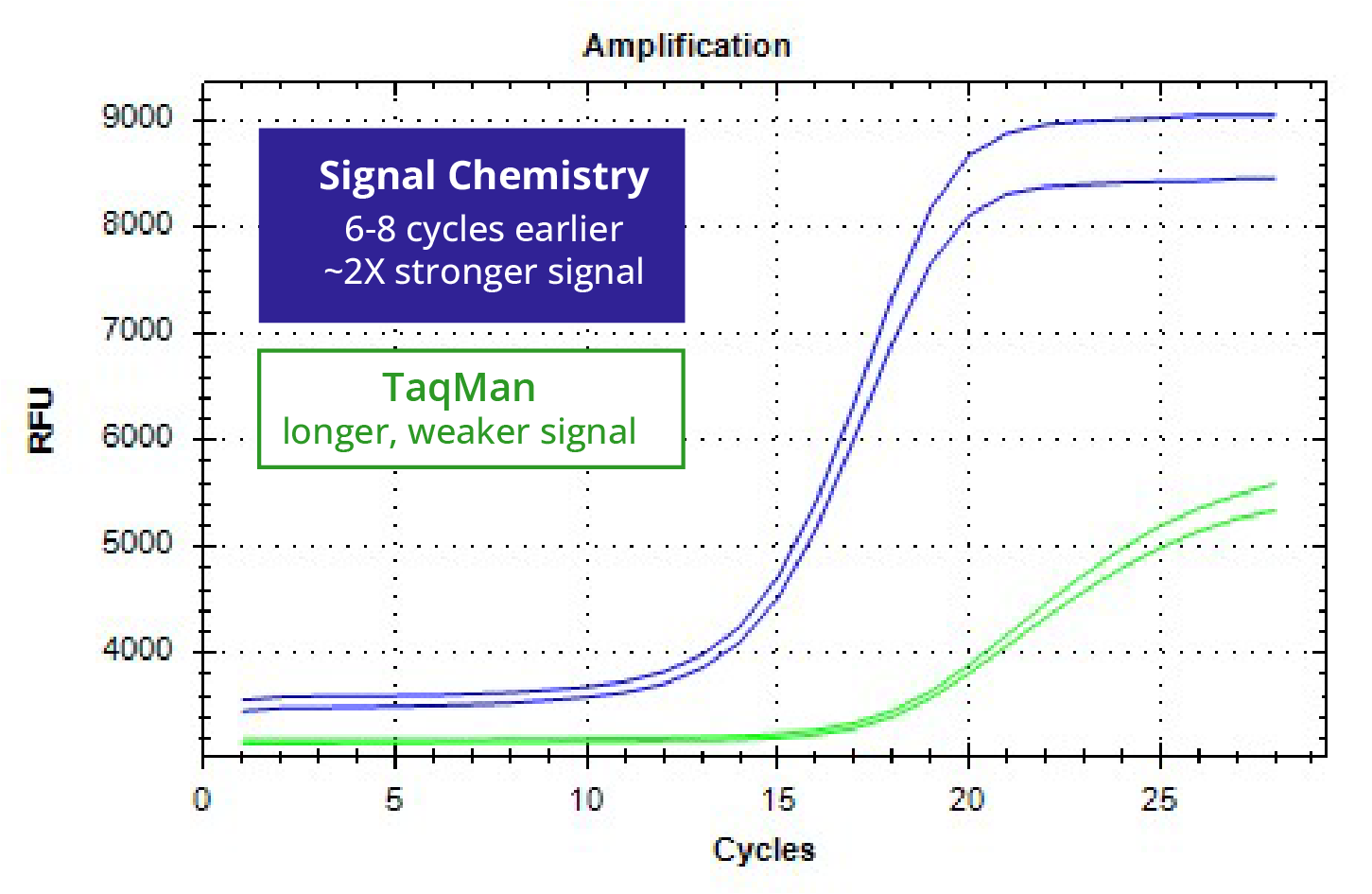
Signal Chemistry generates stronger, earlier signals compared to conventional TaqMan — with tunable intensity and maintained linearity.
Multiplexing Architecture
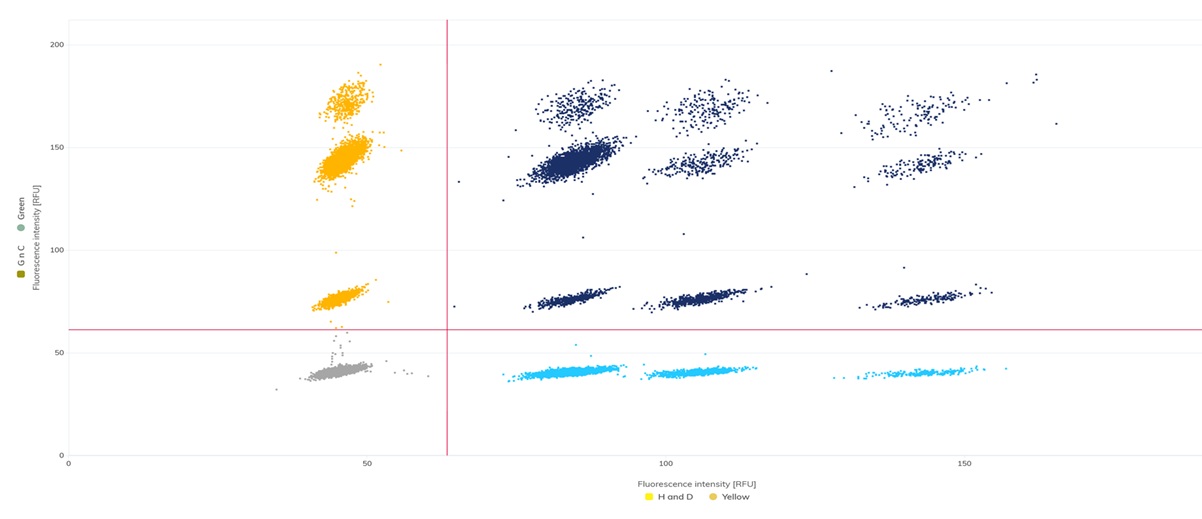
Amplitude modulation combined with color mixing and universal reagents enables multiplex levels conventional fluorogenic chemistries cannot reach.
How It Scales
Because signal generation is decoupled from amplification, each target's fluorescence level can be independently tuned without affecting PCR efficiency.
- 5-plex, 5-color demonstrated on standard qPCR platforms
- 15-plex demonstrated on dPCR with just FAM and HEX
- Up to 30 targets in a single tube demonstrated in dPCR
- High concordance maintained between singleplex and multiplex reactions
- No vendor-specific software or cloud analysis required
Singleplex vs. Multiplex Concordance
Quantitative agreement between singleplex and 4-plex reactions (copies/μL)
| Signaling System | Singleplex | Multiplex |
|---|---|---|
| FAM Low | 178.9 | 184.8 |
| FAM High | 448.9 | 437.6 |
| HEX Low | 127.6 | 131.5 |
| HEX High | 437.6 | 435.3 |
Platform Advantages
Universal Fluorescent Probe System
A shared pool of fluorogenic probes works across all assays. Adding new targets means adding unlabeled primers — not redesigning the reporter system. Scales to high multiplex without scaling cost.
Earlier, Stronger Signals
Signal appears 6–8 cycles earlier than TaqMan, with nearly double the endpoint fluorescence. Reduces no-template control impact and cuts rain in dPCR — critical for low-copy detection.
Controlled, Tunable Signaling
Signal intensity per target is independently tunable, enabling tighter amplitude clusters in 2D dPCR readout plots. Supports automated analysis without proprietary cloud software.
Flexible Platform Chemistry
Supports both primer-based and probe-based signaling. Use iProbes for hotspot mutation detection, or signal primers for straightforward assay conversion from existing workflows.
Drop-In Compatibility
Works on qPCR and dPCR instruments already on your bench. No new hardware purchases, no retraining, no procurement cycles. Deploy new assays on your existing installed base.
Cost Efficiency at Scale
Inexpensive universal probes replace target-specific labeled probes. Per-target costs stay flat as panel size grows — making 30-plex panels economically viable at TaqMan-comparable pricing.
Ready to build your panel?
From KRAS companion diagnostics to custom multiplex workflows — we can help you get there faster.
Contact Us